
What a rear admiral does
- Commands type commands, task forces and major shore organizations
- Leads major directorates on Navy and joint staffs
- Runs major acquisition or research programs
- Serves as deputy commander of fleets and joint commands
- Leads Navy schools such as the Naval War College
How to become a rear admiral
Two-star admirals are selected by a board that reviews the records of one-star admirals, then nominated by the President and confirmed by the Senate. Not every one-star is selected; some retire after a single flag tour. The total number of Navy flag officers on active duty is capped by law, so each promotion depends on an opening.
Rear Admiral pay
In 2026, basic pay for O-8 runs from $13,889 – $19,000 a month, rising with years of service. Basic pay is the same in every branch; housing (BAH) and food (BAS) allowances are paid on top. See the full 2026 military pay chart.
History of the rank
Congress created the rank of rear admiral on 16 July 1862, in recognition of David Farragut's capture of New Orleans that spring. Farragut was among the first officers to hold it.
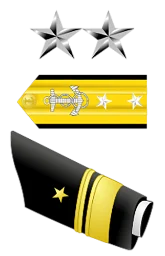
The insignia is two silver stars, and a two-inch stripe with a half-inch stripe on the sleeves.
The title comes from the British navy, where a fleet was split into van, center and rear squadrons and the most junior admiral took the rear. Before 1862 the U.S. Navy had avoided the word admiral altogether and used captain and the temporary title flag officer for its senior commanders.
Medal of Honor recipients who held this rank
Sailors who earned the nation’s highest award for valor while serving as a rear admiral.
World War II · 1941
Isaac C. Kidd
Rear Admiral · Posthumous
Kidd commanded Battleship Division One from his flagship, USS Arizona. When the attack on Pearl Harbor began he went to the bridge and directed the fight as senior officer afloat until Arizona blew up.
World War II · 1942
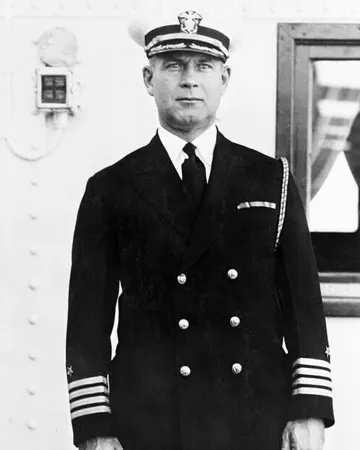
Norman Scott
Rear Admiral · Posthumous
Off Savo Island in October 1942, Scott's force intercepted a Japanese task force headed for Guadalcanal and sank or drove it off. A month later he led his ships into a close-range night battle against a stronger force and was killed in the bombardment. Both actions helped turn back the Japanese push on Guadalcanal.
World War II · 1942
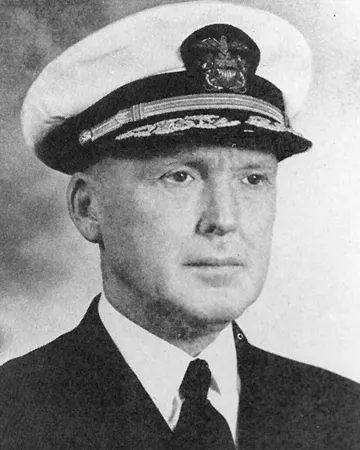
Daniel J. Callaghan
Rear Admiral · Posthumous
On the night of 12 to 13 November 1942, Callaghan led an outgunned American force against a Japanese fleet moving on Guadalcanal. He directed the close-range fight from the bridge of USS San Francisco until he was killed there. The battle helped stop the Japanese offensive.
Equivalent ranks in other services
| Insignia | Branch | Rank |
|---|---|---|
 | Army | Major General (MG) |
 | Marine Corps | Major General (MajGen) |
 | Air Force | Major General (Maj Gen) |
| Space Force | Major General (Maj Gen) |
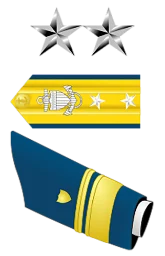 | Coast Guard | Rear Admiral (RADM) |