
How to get in shape for boot camp
Recruit training is easier to learn from when you are not also fighting your own fitness. This plan builds a running base, calisthenics volume and time on your feet over eight weeks, with rest built in.
Last verified November 17, 2026
- Plan length
- 8 weeks
- Training days
- 5 per week
- Rest days
- 2 per week
- Equipment
- Running shoes, pull-up bar, backpack
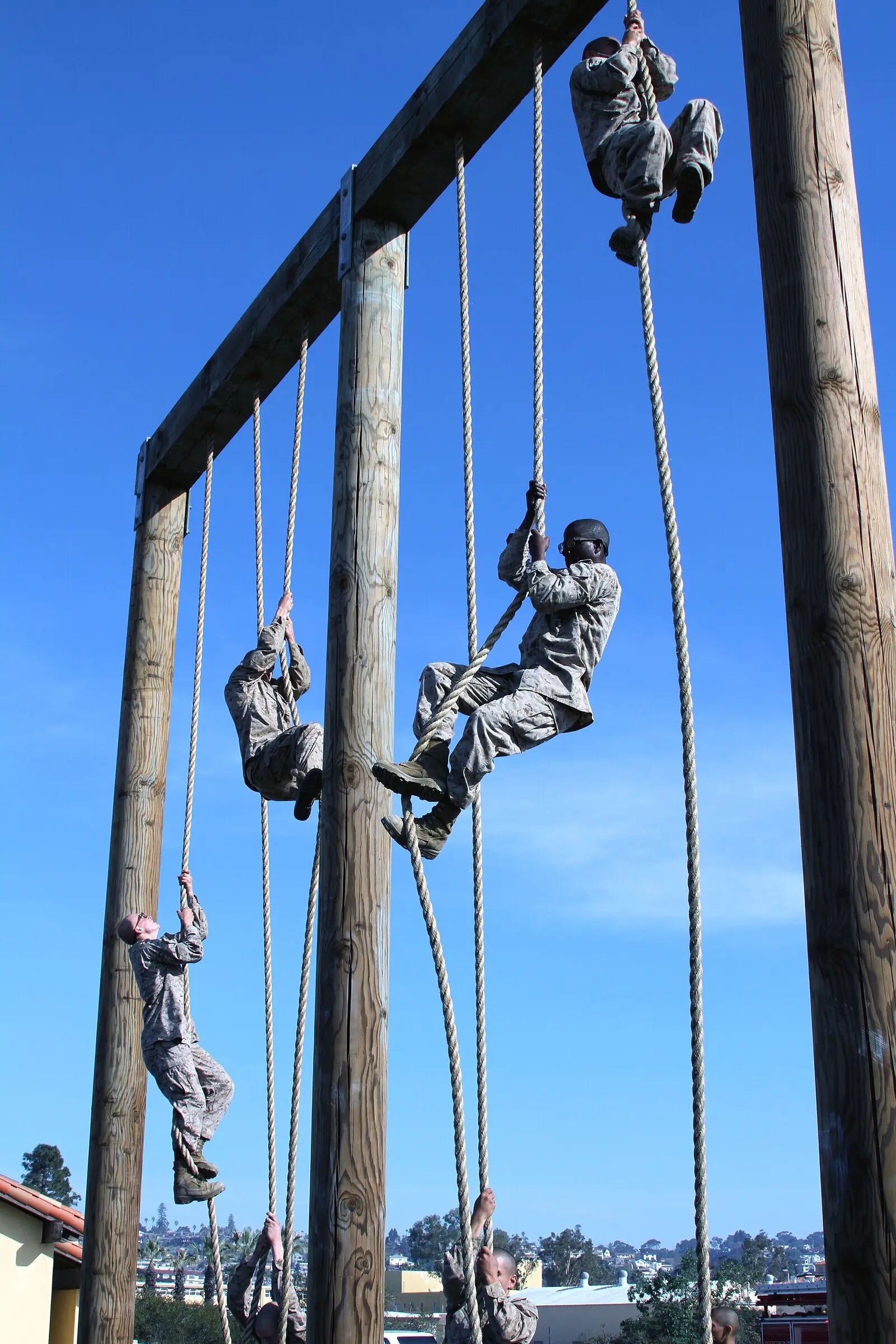
U.S. Marine Corps photo. Use does not imply endorsement.
What each branch tests
Every branch runs its own fitness test, and the events decide what your training should favor. Scoring depends on age and sex and the standards change, so use the linked guides for current numbers and confirm the entry requirements for your ship date with your recruiter.
- Army: the Army AFT includes hand-release push-ups, a plank and a 2-mile run.
- Marine Corps: the Marine Corps PFT is pull-ups or push-ups, a plank and a 3-mile run. Marines also take the CFT.
- Navy: the Navy PRT includes a plank and a 1.5-mile run.
- Air Force: the Air Force PFRA uses a 2-mile run or the 20 m HAMR shuttle, plus strength and core components.
- Space Force: the Space Force HPA uses a 2-mile run or the 20 m HAMR shuttle, plus strength and core components.
- Coast Guard: the Coast Guard PFT includes a plank and a 1.5-mile run.
The first assessment you take on arrival may not be the same as your branch's test of record. Ask your recruiter exactly what you will be tested on in the first week, then train for that and for the full test. The fitness test hub lists all six.
How long you need
Eight weeks is enough to make a real difference if you can already jog for ten minutes and do a few push-ups. If you are starting further back, give yourself longer and repeat weeks rather than skipping ahead.
- Cannot run 10 minutes without stopping: plan on 12 to 16 weeks. Repeat weeks 1 and 2 of the running table until they feel easy.
- Can run 1.5 miles and do 10 or more push-ups: the 8-week plan as written fits you.
- Already training four days a week: start at week 3 and spend the extra time on your weakest test event.
- Less than four weeks out: do not cram. Run easy three times a week, do sub-maximal push-ups and planks, and arrive rested.
Weekly structure
Five training days and two rest days. Hard days alternate with easier ones so your legs and shoulders recover between sessions. Move the days to fit your week, but keep at least one full rest day before the long session.
| Day | Session | What to do |
|---|---|---|
| Monday | Easy run + calisthenics | Easy run from the table, then push-up, pull-up and core sets |
| Tuesday | Speed day | Warm up 10 minutes, speed session from the table, walk 5 minutes |
| Wednesday | Calisthenics + legs | Push-ups, pull-ups, squats, lunges, planks. No running |
| Thursday | Easy run | Easy run, then 10 minutes of core work |
| Friday | Rest | Walk, stretch, sleep |
| Saturday | Long run or ruck | Long run most weeks. Swap for a ruck walk every second week |
| Sunday | Rest | Full rest day |
You can log these sessions and your practice test events in Gruntz so you can see what changed from week to week.
Running progression
Most of your running should be easy, at a pace where you could speak in full sentences. Easy miles build the base. One faster session a week from week 3 teaches you test pace. If a week feels too hard, repeat it before moving on.
| Week | Easy runs (Mon, Thu) | Speed day (Tue) | Long run (Sat) |
|---|---|---|---|
| 1 | 20 min: run 2 min, walk 1 min | Easy 20 min run/walk | 25 min run/walk |
| 2 | 20 min: run 3 min, walk 1 min | Easy 20 min run/walk | 30 min run/walk |
| 3 | 20 min continuous | 6 x 1 min brisk, 2 min walk between | 30 min |
| 4 | 25 min | 6 x 400 m at goal test pace, 2 min rest | 35 min |
| 5 | 25 min | 4 x 800 m at goal test pace, 3 min rest | 40 min |
| 6 | 30 min | 20 min steady, comfortably hard | 45 min |
| 7 | 30 min | 5 x 800 m at goal test pace, 2 min 30 s rest | 45 to 50 min |
| 8 | 20 min | Time trial at your test distance | 30 min easy |
For a full interval and tempo plan built around one test distance, use the 2-mile run training plan. It also covers how to adapt for 1.5 and 3 miles.
Calisthenics progression
Test your maximum once in week 1: push-ups in good form, pull-ups from a dead hang, and one plank hold. Then train below that limit. Sets at about half your maximum, repeated often, add reps faster than going to failure every session.
- Push-ups: 5 sets at half your max, 60 to 90 seconds rest, three days a week. Add one rep per set each week. Army, Air Force and Space Force recruits should practice the hand-release push-up.
- Pull-ups: if you have none, do 5 slow negatives and 3 dead hangs of 20 seconds, three days a week. If you have some, follow how to do more pull-ups.
- Plank: 4 holds at half your max, twice a week, building as shown in the plank training guide.
- Legs: 3 x 15 bodyweight squats, 3 x 10 lunges per leg and 3 x 15 calf raises on Wednesday.
- Core: 3 x 10 dead bugs per side and 3 x 20 flutter kicks after each easy run.
Retest in week 4 and week 8, and reset your working sets from the new numbers. Do not test more often than that.
Rucking and time on feet
Recruit training means long days standing, marching and carrying gear. Hours on your feet matter as much as gym fitness. A loaded walk every second Saturday prepares your feet, hips and shoulders without the impact of extra running.
- Start with 10 to 15 lb in a snug backpack for 2 miles at a brisk walk.
- Add either a mile or 5 lb each time, never both.
- Cap it at about 4 miles and 25 lb before you ship. You will build the rest there.
- Walk, do not run, under load.
- On weekdays, stand and walk more: take stairs, walk 30 minutes on rest days.
If load carriage is a large part of your pipeline, the ruck march training plan has a longer progression.
Swimming for Navy and Coast Guard
Navy and Coast Guard recruit training both include swim qualification. The requirements are set by each service, so ask your recruiter for the current ones. Other pipelines may include water training too. If you are not comfortable in deep water, fix that before you ship, because it is much harder to learn under time pressure.
- Swim twice a week for 20 to 30 minutes in place of one easy run.
- Practice jumping in feet first, surfacing calmly and floating on your back.
- Build to treading water for 5 minutes without touching the wall.
- Build to 50 yards of continuous swimming with any stroke, then 100.
- If you cannot swim, take lessons now. Always swim where a lifeguard is on duty.
Common mistakes
- Starting too hard. Doubling your running in week 1 is the usual way people get hurt before they ship. Increase weekly running time by about 10 percent.
- Maxing out every day. Test every four weeks. Train below your limit in between.
- Skipping rest days. Fitness is built while you recover. Keep both rest days.
- Training only the fun events. Put your weakest event first in the session, when you are fresh.
- Sloppy reps. Practice to the form your branch tests. Reps that would not count on the test do not count in training.
- Arriving exhausted. Cut volume by half in the final week and sleep.
This is general training information, not medical advice. If you have a health condition or have been inactive, talk to a doctor before starting. Stop and get checked for sharp pain or pain that does not go away.
Questions
Fit enough to meet your branch's entry requirements with room to spare, and to train every day without breaking down. As a personal training target, not an official standard, aim to run for 30 minutes without stopping and to do several sets of push-ups and planks in good form. Check the current requirements with your recruiter and in the fitness test guides.
The required number depends on your branch, age and sex, and it changes, so read the guide for your test. A sensible training target is to be comfortably above your branch's minimum, in strict form, when you are already tired. Being able to do 5 sets of 15 to 20 clean push-ups with a minute of rest is a solid place to arrive.
At least your test distance without stopping, at a controlled pace: 1.5 miles for Navy and Coast Guard, 2 miles for Army, Air Force and Space Force, 3 miles for the Marine Corps. A good training target is to run 30 to 45 minutes easy, which covers more than any of those distances.
It is enough to build a base if you can already jog 10 minutes and train consistently. It is not enough to go from fully inactive to confident. If you are starting from zero, take 12 to 16 weeks and repeat the early weeks.
Run in running shoes. If you own boots, walking and rucking in them once a week helps your feet adapt, but there is no need to buy a pair for this. You will be issued boots at recruit training, so the goal now is tougher feet and stronger legs, not matching the gear.
Gruntz is an independent training app built by a former U.S. Marine. It is not affiliated with or endorsed by the U.S. Department of Defense or any military branch.