
Ruck march training plan
Rucking is walking fast with a loaded pack. It rewards patience: build distance and weight slowly, look after your feet, and the miles come.
Last verified November 17, 2026
- Plan length
- 12 weeks
- Rucks per week
- 1 to 2
- Starting load
- About 10 to 15% of bodyweight
- Training pace
- 15 to 17 min per mile
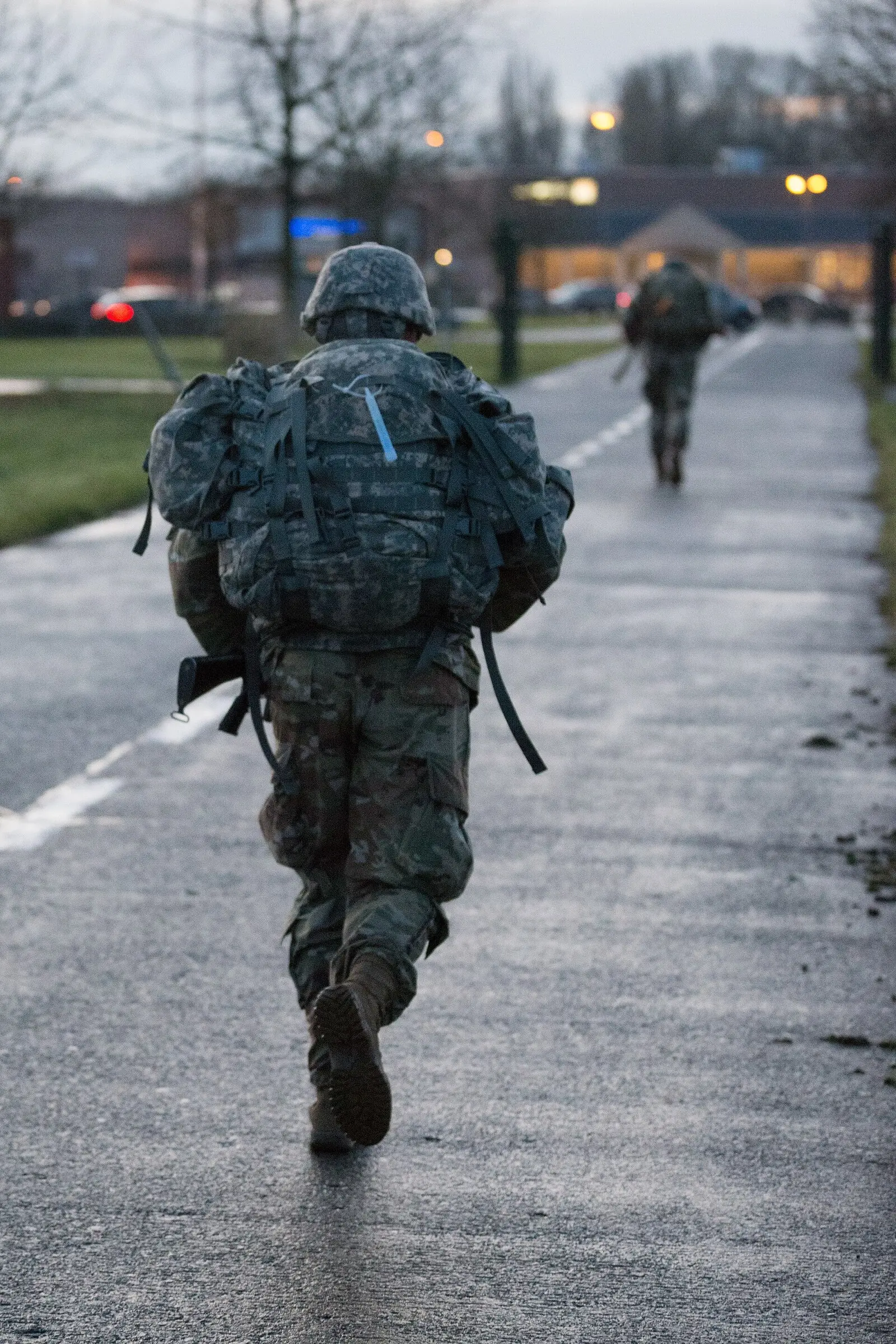
U.S. Army photo by Pierre-Etienne Courtejoie. Use does not imply endorsement.
What a ruck standard looks like
There is no single military ruck standard. Distance, load, time limit, terrain and what counts toward the pack weight are set by the unit, school or course you are attending, and they change. A timed march of several miles under a set load is a common format, and 12 miles is a distance many soldiers and Marines train toward.
Get the actual standard in writing from your unit or the course's published guidance before you plan. Ask four things: the distance, the time limit, the pack weight, and whether that weight is measured dry, before water and food. Then set your training load and goal pace from those answers.
Rucking is separate from your branch's fitness test. For those events, see the fitness test guides.
Starting weight and pace
Start lighter than you think you need. A pack at about 10 to 15 percent of your bodyweight is enough for the first weeks. For many people that is 15 to 25 lb. Your joints, feet and shoulders adapt more slowly than your lungs, so the load should feel easy at first.
- Pace: walk at 15 to 17 minutes per mile. A 15-minute mile is a common training benchmark and is a fast walk, not a stroll.
- Stride: shorter and quicker, not longer. Overstriding under load is hard on shins and hips.
- Posture: tall chest, slight forward lean from the ankles, arms swinging.
- Surface: start on flat, even ground. Add hills and trails after week 4.
Time every ruck and note the load. Pace per mile at a known weight is the number that tells you whether you are improving. You can log each ruck in Gruntz alongside your other sessions.
Week-by-week progression
The plan changes one thing at a time: distance or load, never both in the same week. Every fourth week is lighter so your body can catch up. The loads below are examples that finish at 35 lb. If your standard uses a different weight, scale the column so the final three weeks are at your required load.
| Week | Long ruck | Load | Short ruck (optional) |
|---|---|---|---|
| 1 | 3 miles | 20 lb | 2 miles at 20 lb |
| 2 | 4 miles | 20 lb | 2 miles at 20 lb |
| 3 | 4 miles | 25 lb | 3 miles at 20 lb |
| 4 | 3 miles (lighter week) | 25 lb | None |
| 5 | 5 miles | 25 lb | 3 miles at 25 lb |
| 6 | 6 miles | 25 lb | 3 miles at 30 lb |
| 7 | 6 miles | 30 lb | 3 miles at 30 lb |
| 8 | 4 miles (lighter week) | 30 lb | None |
| 9 | 8 miles | 30 lb | 3 miles at 35 lb |
| 10 | 8 miles | 35 lb | 4 miles at 35 lb |
| 11 | 10 miles | 35 lb | 3 miles at 35 lb |
| 12 | 12 miles | 35 lb | None. Walk 2 miles unloaded early in the week |
If you miss the pace or finish a week with sore joints rather than tired muscles, repeat that week. If your event is on a fixed date, count back from it and leave 7 to 10 days between your last long ruck and the event.
How often to ruck
One long ruck a week is the core of the plan. A second, shorter ruck helps once the first month is behind you. More than two loaded sessions a week adds wear faster than it adds fitness for most people.
- Long ruck: once a week, with a rest day before and after.
- Short ruck: once a week, at least two days away from the long one.
- Running: two or three easy runs of 20 to 40 minutes without a pack. Running fitness carries over to ruck pace. The 2-mile run training plan covers the faster work.
- Strength: two sessions a week, described below.
- Rest: at least one day with no training at all.
Packing and fit
A badly packed ruck feels heavier than it is. The aim is a load that sits high, close to your spine and does not move.
- Put the heaviest items high and against the frame, between your shoulder blades.
- Fill empty space with soft items so nothing shifts or bounces.
- Tighten the shoulder straps until the pack rides high on your back, not on your lower back.
- Use the sternum strap. Use the hip belt if your standard allows it, to move weight to your hips.
- Weigh the packed ruck on a scale. Guessing leads to training too light or too heavy.
- Carry water on top of the required weight unless you are told otherwise.
Train with the pack and boots you will use for the event once you are past the first few weeks. Small problems such as a strap that rubs show up at mile 6, not mile 2.
Foot care
Feet end more rucks than fitness does. Most blisters come from moisture, friction and boots that have not been broken in.
- Break boots in with 20 or more miles of walking before a long ruck.
- Wear wool-blend or synthetic socks, not cotton. Many people add a thin liner sock underneath.
- Keep toenails trimmed short and straight.
- Lace boots snugly over the instep so your heel does not slide.
- Stop at the first hot spot and tape or cover it. Waiting turns it into a blister.
- Carry dry socks on rucks of 8 miles or more and change at the halfway point.
- After each ruck, wash and dry your feet and let boots air out.
Strength work
Stronger legs, hips and trunk make a given load a smaller share of what you can handle. Two sessions a week of 30 to 40 minutes is enough. Pick weights that leave two reps in reserve, and add load in small steps.
| Exercise | Sets x reps | Why |
|---|---|---|
| Goblet or back squat | 3 x 8 | Leg strength for hills and long miles |
| Romanian deadlift | 3 x 8 | Hamstrings, glutes and lower back |
| Step-ups | 3 x 10 per leg | Single-leg strength for climbs |
| Walking lunges | 3 x 10 per leg | Hips and balance |
| Calf raises | 3 x 15 | Calves and ankles |
| Rows or pull-ups | 3 x 8 | Upper back to hold the pack |
| Suitcase carry | 3 x 40 m per side | Trunk stiffness under load |
| Plank | 3 holds | Core endurance |
For the plank holds, use the progression in the plank training guide. For upper-back work, see how to do more pull-ups.
This is general training information, not medical advice. Load carriage is demanding on feet, knees, hips and back. Stop and get checked for sharp pain, numbness or pain that does not go away with rest.
Questions
About 10 to 15 percent of your bodyweight, which for many people is 15 to 25 lb. Walk 2 to 3 miles with it and see how your feet and shoulders feel the next day. Add 5 lb at a time, and only in weeks where the distance stays the same.
It depends on the load and the standard you are training for, which your unit or school sets. A common training benchmark is a 15-minute mile, which works out to 3 hours for 12 miles. Treat that as a pace to train toward, and confirm the actual time and weight you will be held to.
Once or twice a week. One long ruck builds the distance and an optional short ruck keeps the skill. Fill the other days with easy running, strength work and rest.
Not as a training habit. Running under load multiplies the impact on your knees, shins and back. Build speed by walking faster and by running without a pack. If your event rewards a shuffle on flats and downhills, practice it in short stretches late in the plan, not every week.
Keep feet dry, reduce friction and deal with hot spots early. That means broken-in boots that fit, non-cotton socks, a sock change on long rucks and tape on any spot that starts to rub. Building distance gradually also lets the skin toughen.
Gruntz is an independent training app built by a former U.S. Marine. It is not affiliated with or endorsed by the U.S. Department of Defense or any military branch.