
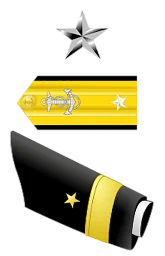
What a rear admiral (lower half) does
- Commands a carrier strike group or expeditionary strike group
- Commands Navy regions and major shore commands
- Leads directorates on fleet, Navy and joint staffs
- Serves as deputy commander of larger organizations
- Represents the Navy in international and interagency settings
How to become a rear admiral (lower half)
Captains are selected for flag rank by a selection board, then nominated by the President and confirmed by the Senate. The number of flag officers is limited by law.
Rear Admiral (lower half) pay
In 2026, basic pay for O-7 runs from $11,540 – $17,242 a month, rising with years of service. Basic pay is the same in every branch; housing (BAH) and food (BAS) allowances are paid on top. See the full 2026 military pay chart.
History of the rank
Commodore became a permanent Navy rank in July 1862, was left off the active list by an 1899 act, and was revived in 1943 for wartime use, with promotions ending in 1947. In the early 1980s the one-star grade came back, briefly titled commodore admiral and then commodore, and in 1985 Congress (Public Law 99-145) replaced it with rear admiral (lower half).
The insignia is one silver star on the collar. On the sleeves the grade wears a single two-inch gold stripe.
Both one-star and two-star admirals are titled "Rear Admiral" when addressed; the "lower half" is used only for the grade.
Equivalent ranks in other services
| Insignia | Branch | Rank |
|---|---|---|
 | Army | Brigadier General (BG) |
 | Marine Corps | Brigadier General (BGen) |
 | Air Force | Brigadier General (Brig Gen) |
| Space Force | Brigadier General (Brig Gen) |
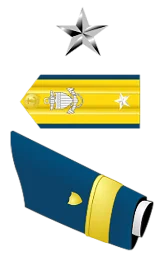 | Coast Guard | Rear Admiral (lower half) (RDML) |