
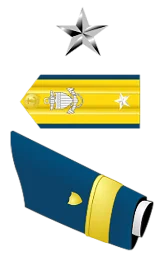
What a rear admiral (lower half) does
- Commands a Coast Guard district, directing search and rescue, law enforcement and port security in that region
- Leads a directorate or assistant commandant's office at Coast Guard headquarters
- Serves as deputy commander or chief of staff at one of the two area commands
- Directs major acquisition programs, such as new cutter or aircraft classes
- Works with other federal agencies, foreign coast guards and navies on shared missions
How to become a rear admiral (lower half)
A board reviews the records of eligible captains and recommends officers for flag rank. The President nominates those selected and the Senate must confirm them. The law caps the total number of Coast Guard flag officers, so selection is very limited, and one-star officers must be selected again by a board to reach two stars.
Rear Admiral (lower half) pay
In 2026, basic pay for O-7 runs from $11,540 – $17,242 a month, rising with years of service. Basic pay is the same in every branch; housing (BAH) and food (BAS) allowances are paid on top. See the full 2026 military pay chart.
History of the rank
For most of its early history the Coast Guard had very few flag officers. By the 1930s the Commandant held the rank of rear admiral; Russell Waesche, for example, became Commandant as a rear admiral on 14 June 1936.
During World War II the Navy and Coast Guard used a temporary one-star commodore rank. The permanent one-star grade was briefly called commodore admiral and then commodore in the early 1980s, and Public Law 99-145 renamed it rear admiral (lower half) on 8 November 1985.
The insignia is one silver star on the collar and shoulder boards, and a single two-inch gold stripe on the sleeves under the Coast Guard shield.
In 2025 the Coast Guard dropped its numbered districts for regional names, such as Northeast District for the former First District, without changing district boundaries.
Equivalent ranks in other services
| Insignia | Branch | Rank |
|---|---|---|
 | Army | Brigadier General (BG) |
 | Marine Corps | Brigadier General (BGen) |
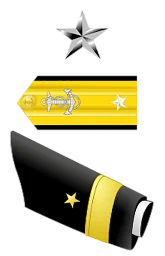 | Navy | Rear Admiral (lower half) (RDML) |
 | Air Force | Brigadier General (Brig Gen) |
| Space Force | Brigadier General (Brig Gen) |