
What a rear admiral does
- Commands one of the larger or busier Coast Guard districts
- Serves as Superintendent of the U.S. Coast Guard Academy
- Leads an assistant commandant's directorate at headquarters
- Directs the service's cyber, intelligence or acquisition organizations
- Represents the Coast Guard on interagency and international bodies
How to become a rear admiral
One-star admirals are considered for two-star rank by a selection board. The President nominates selected officers and the Senate confirms them.
Rear Admiral pay
In 2026, basic pay for O-8 runs from $13,889 – $19,000 a month, rising with years of service. Basic pay is the same in every branch; housing (BAH) and food (BAS) allowances are paid on top. See the full 2026 military pay chart.
History of the rank
Rear admiral was the first flag rank held by Coast Guard officers. William E. Reynolds, Commandant from 1919, was the first Coast Guard officer promoted to rear admiral, and Russell Waesche took office as Commandant with that rank in 1936.
The rank title comes from the age of sail, when the rear admiral commanded the rear division of a fleet. The Coast Guard took it from the Navy, where Congress created the rank on 16 July 1862.
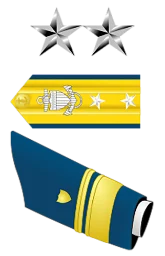
The insignia is two silver stars on the collar and shoulder boards, and on the sleeves a two-inch gold stripe with a half-inch stripe above, under the Coast Guard shield.
Equivalent ranks in other services
| Insignia | Branch | Rank |
|---|---|---|
 | Army | Major General (MG) |
 | Marine Corps | Major General (MajGen) |
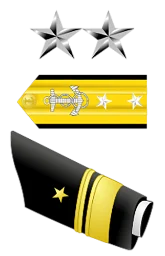 | Navy | Rear Admiral (RADM) |
 | Air Force | Major General (Maj Gen) |
| Space Force | Major General (Maj Gen) |