
What a vice admiral does
- Commands Coast Guard Atlantic Area or Pacific Area
- Serves as Deputy Commandant for Operations, overseeing the service's missions
- Leads one of the headquarters deputy commandant directorates for people and for ships, aircraft and systems, which replaced the single Mission Support directorate in July 2025
- Takes on joint and interagency leadership roles, including with the Department of Homeland Security and the Department of Defense
- Advises the Commandant as a member of the service's senior leadership
How to become a vice admiral
Vice admiral is tied to specific positions. The President nominates an officer for a three-star position and the Senate confirms the appointment. An officer usually holds the grade only while serving in the position, and keeping it in retirement requires approval.
Vice Admiral pay
In 2026, basic pay for O-9 runs from $19,000 – $19,000 a month, rising with years of service. Basic pay is the same in every branch; housing (BAH) and food (BAS) allowances are paid on top. See the full 2026 military pay chart.
History of the rank
The Coast Guard's first vice admiral was its Commandant during World War II: Russell Waesche was promoted to vice admiral on 10 March 1942, and later became the service's first full admiral.
The Vice Commandant was a vice admiral until 2016, when the post was raised to four stars. The area commanders and deputy commandants remain the service's three-star positions, and the 2025 Force Design 2028 reorganization reshaped headquarters and cut the number of flag officer billets.
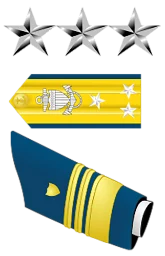
The insignia is three silver stars on the collar and shoulder boards, and on the sleeves a two-inch gold stripe with two half-inch stripes above, under the Coast Guard shield.
Equivalent ranks in other services
| Insignia | Branch | Rank |
|---|---|---|
 | Army | Lieutenant General (LTG) |
 | Marine Corps | Lieutenant General (LtGen) |
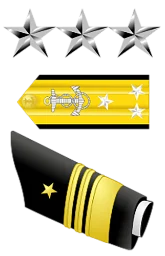 | Navy | Vice Admiral (VADM) |
 | Air Force | Lieutenant General (Lt Gen) |
| Space Force | Lieutenant General (Lt Gen) |