
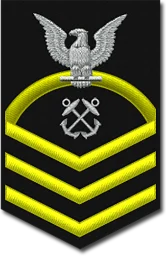
What a chief petty officer does
- Serves as division leading chief petty officer (LCPO), responsible for the division's Sailors, work and readiness
- Acts as the technical authority for the rating aboard the command
- Advises the division officer and department head on personnel and maintenance
- Trains junior officers as well as enlisted Sailors
- Sits on command boards and as a member of the chief petty officers' mess
How to become a chief petty officer
Making chief has two stages. First, an E-6 with at least 36 months in rate and the commanding officer's recommendation takes the E-7 advancement exam. Under the long-standing rule, roughly the top 60 percent of each rating by final multiple score (which for E-7 combines evaluations and the exam) become selection-board eligible. Second, a board reviews each eligible Sailor's full record, with weight on sustained performance and leadership. Since fiscal year 2026 most active-duty candidates go through a Senior Enlisted Marketplace screening board and advance as they are matched to chief billets, while exempt communities such as submarine and nuclear ratings still use a traditional selection board. The boards are announced each year by NAVADMIN. Selectees go through a period of CPO initiation training before they pin on anchors.
Chief Petty Officer pay
In 2026, basic pay for E-7 runs from $3,932 – $7,067 a month, rising with years of service. Basic pay is the same in every branch; housing (BAH) and food (BAS) allowances are paid on top. See the full 2026 military pay chart.
History of the rank
The Navy established the chief petty officer rate on 1 April 1893, under General Order 409 of 25 February 1893. The new rate covered nine ratings at first, among them master-at-arms, boatswain's mate, gunner's mate, quartermaster, yeoman and apothecary.
The chief's rating badge adds an arc over three chevrons, and a fouled anchor with the letters "USN" became the chief's collar and cap device. Chiefs also changed into a uniform much like an officer's, with khakis for working dress.
Each year chiefs mark 1 April as the birthday of the chief petty officer and recall the history of the mess, which the Navy calls the backbone of its enlisted force.
Medal of Honor recipients who held this rank
Sailors who earned the nation’s highest award for valor while serving as a chief petty officer.
World War II · 1941
John W. Finn
Aviation Chief Ordnanceman
When Japanese planes struck Naval Air Station Kaneohe Bay on 7 December 1941, Finn set up a .50-caliber machine gun on an exposed part of the parking ramp and fired back through the strafing and bombing. He was wounded many times and left his gun only when ordered to. After first aid he went back to help rearm the squadron's planes.
World War II · 1941
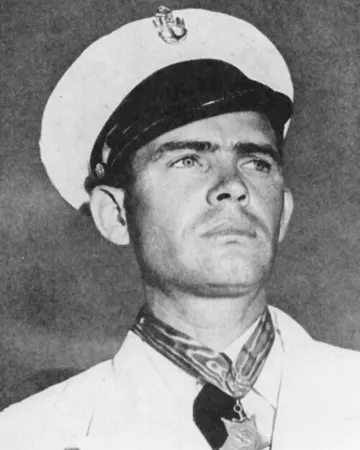
Peter Tomich
Chief Watertender · Posthumous
Tomich was in the engineering plant of USS Utah when the ship was hit and began to capsize at Pearl Harbor. He stayed at his post until every boiler was secured and all of his fireroom crew had gotten out. He lost his life doing it.
Operation Enduring Freedom · 2012
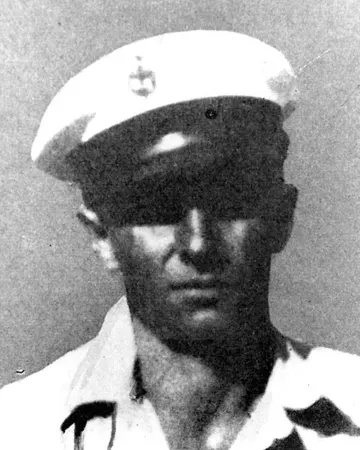
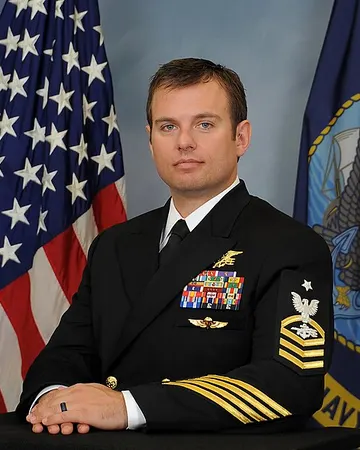
Edward C. Byers Jr.
Chief Petty Officer
Byers was a SEAL on a hostage rescue mission in Afghanistan. As the breacher, he stood in the doorway under fire tearing down layers of heavy blankets, then rushed in after the first assaulter fell. He fought two guards, found the American hostage by his voice, covered him with his own body and pinned another guard with his bare hands, saving the hostage and several teammates.
Equivalent ranks in other services
| Insignia | Branch | Rank |
|---|---|---|
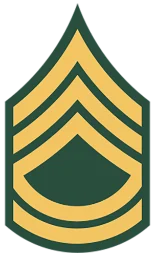 | Army | Sergeant First Class (SFC) |
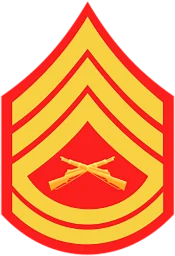 | Marine Corps | Gunnery Sergeant (GySgt) |
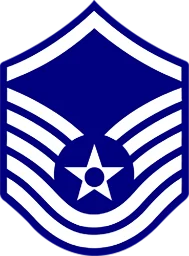 | Air Force | Master Sergeant (MSgt) |
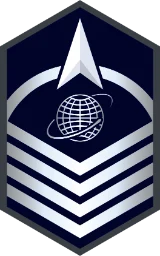 | Space Force | Master Sergeant (MSgt) |
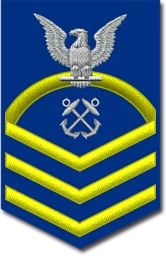 | Coast Guard | Chief Petty Officer (CPO) |