

What a chief warrant officer 3 does
- Instructor pilot, maintenance test pilot or aviation safety officer
- Brigade-level technician or senior warrant in a battalion
- Supervises other warrant officers and NCOs in a technical section
- Integrates the specialty into the unit plan and exercises
- Advises commanders on readiness, risk and training in the field
How to become a chief warrant officer 3
Promotion to CW3 is by selection. A centralized Department of the Army board reviews the records of eligible CW2s each year, weighing evaluations, assignments and education. Federal law bars a chief warrant officer from being considered until completing two years on active duty in the current grade, and the Warrant Officer Advanced Course is the professional education course that prepares officers for this level.
Chief Warrant Officer 3 pay
In 2026, basic pay for W-3 runs from $5,223 – $9,163 a month, rising with years of service. Basic pay is the same in every branch; housing (BAH) and food (BAS) allowances are paid on top. See the full 2026 military pay chart.
History of the rank
The CW3 grade traces to the 1949 law that created four warrant officer grades, though separate insignia for each did not arrive until the 1950s.
The current silver bar with three black squares belongs to the family of insignia approved by the Chief of Staff on 10 June 1970 and worn from 1 July 1972. Like all Army warrant officers since 2004, a CW3 wears the insignia of a basic branch.
Equivalent ranks in other services
| Insignia | Branch | Rank |
|---|---|---|
 | Marine Corps | Chief Warrant Officer 3 (CWO3) |
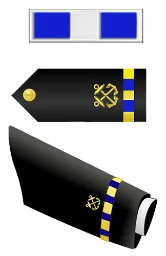 | Navy | Chief Warrant Officer 3 (CWO3) |
| Air Force | Chief Warrant Officer 3 (CWO3) | |
| Coast Guard | Chief Warrant Officer 3 (CWO3) |