
What a admiral does
- Serves as Chief of Naval Operations or Vice Chief of Naval Operations
- Commands U.S. Pacific Fleet or U.S. Fleet Forces Command
- Commands combatant commands such as U.S. Indo-Pacific Command
- Serves as Chairman or Vice Chairman of the Joint Chiefs of Staff
- Leads Naval Reactors
How to become a admiral
Like vice admiral, four-star rank is tied to a position designated under 10 U.S.C. 601. The President nominates an officer, usually a vice admiral, for a specific four-star job, and the Senate confirms. The Chief of Naval Operations is appointed for a four-year term under 10 U.S.C. 8033, and the Senate votes on each four-star nomination separately.
Admiral pay
In 2026, basic pay for O-10 runs from $19,000 – $19,000 a month, rising with years of service. Basic pay is the same in every branch; housing (BAH) and food (BAS) allowances are paid on top. See the full 2026 military pay chart.
History of the rank
Congress created the rank of admiral on 25 July 1866 for David Farragut, the first U.S. Navy admiral.
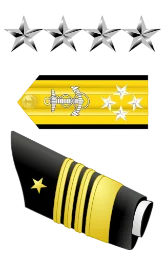
The insignia is four silver stars, and a two-inch stripe with three half-inch stripes on the sleeves.
When Farragut died in 1870, David Dixon Porter succeeded him; after Porter's death in 1891 no one was promoted to the grade. Congress authorized George Dewey's unique title of Admiral of the Navy in 1899, and in 1915 it authorized an admiral for each of the Atlantic, Pacific and Asiatic Fleets, bringing four-star rank back for the Navy's senior commanders.
Equivalent ranks in other services
| Insignia | Branch | Rank |
|---|---|---|
 | Army | General (GEN) |
 | Marine Corps | General (Gen) |
 | Air Force | General (Gen) |
| Space Force | General (Gen) |
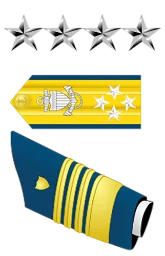 | Coast Guard | Admiral (ADM) |