
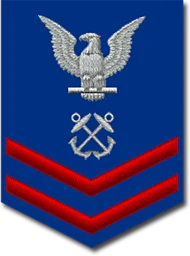
What a petty officer second class does
- Can serve as coxswain, boarding officer or crew lead in the field
- Supervises maintenance and operations in the rating
- Trains junior petty officers and non-rated members
- Stands supervisory watches aboard cutters and stations
- Writes and reviews input for junior members' evaluations
How to become a petty officer second class
Advancement to E-6 follows the same SWE process as E-5: eligibility (time in grade, courses, "Ready" recommendation), the annual servicewide exam and ranking by final multiple against vacancies. Senior commanders can also advance an outstanding E-4, E-5 or E-6 one grade under the Meritorious Advancement Program, within yearly quotas set by ALCOAST 053/24 and reissued unchanged in ALCOAST 066/26; only the Commandant or Vice Commandant may meritoriously advance a member to E-7.
Petty Officer Second Class pay
In 2026, basic pay for E-5 runs from $3,343 – $4,422 a month, rising with years of service. Basic pay is the same in every branch; housing (BAH) and food (BAS) allowances are paid on top. See the full 2026 military pay chart.
History of the rank
Second Class petty officer has been part of the Coast Guard structure since the 1920 adoption of Navy rates.
The rating badge carries two chevrons under the eagle and rating mark.
Second Class petty officers do much of the hands-on leading in the service's small-boat work, where coxswain and boarding qualifications carry real responsibility.
Equivalent ranks in other services
| Insignia | Branch | Rank |
|---|---|---|
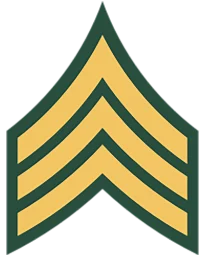 | Army | Sergeant (SGT) |
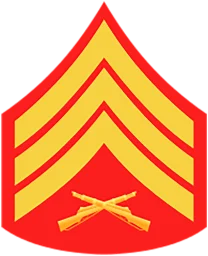 | Marine Corps | Sergeant (Sgt) |
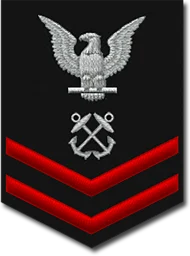 | Navy | Petty Officer Second Class (PO2) |
 | Air Force | Staff Sergeant (SSgt) |
 | Space Force | Sergeant (Sgt) |